
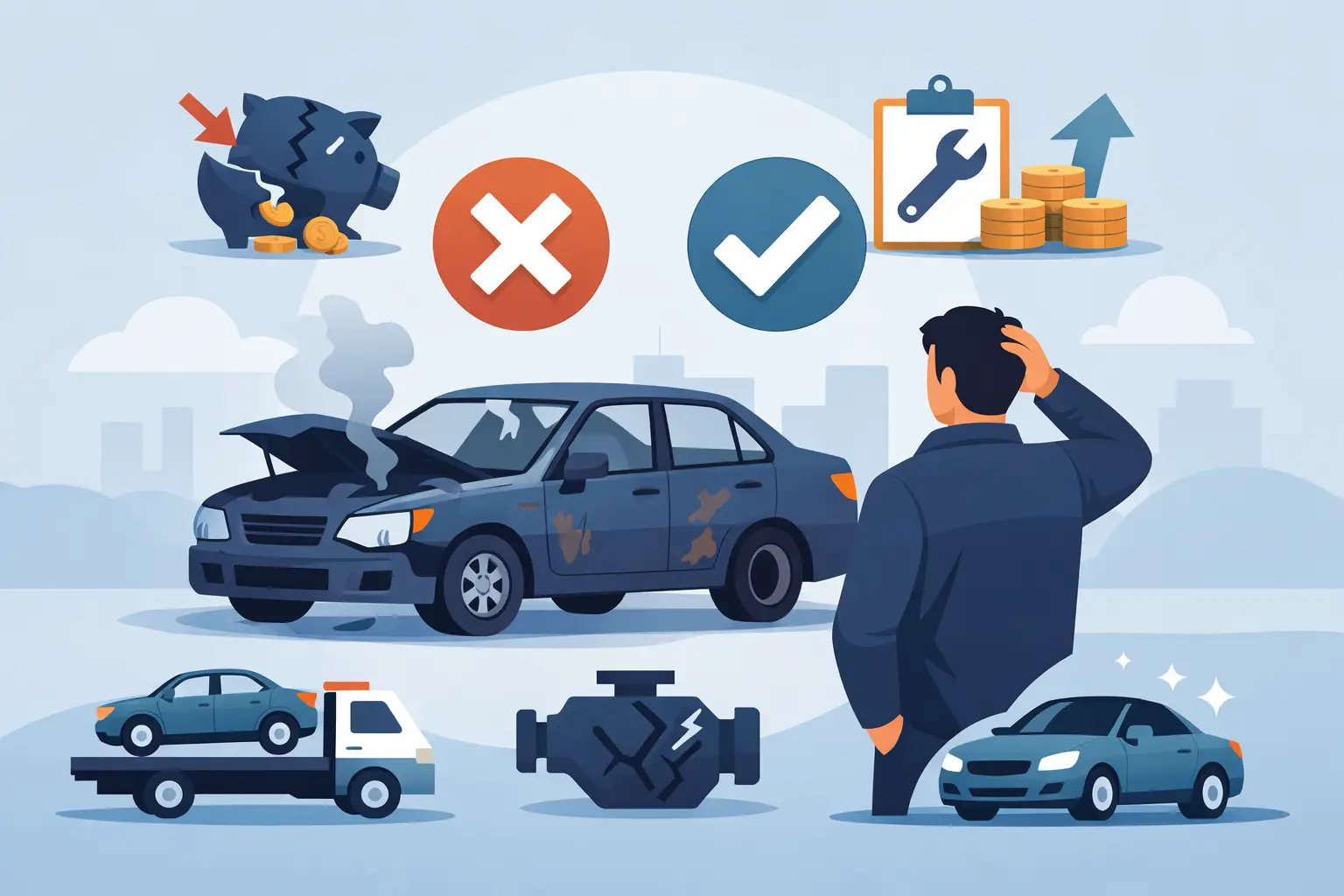
Your mechanic has just quoted more than you expected, the rego is due, and the car has already spent too much time sitting in the driveway. These are often the top signs your car is not worth repairing. The real question is not whether the vehicle can be fixed. Almost anything can be fixed with enough money. The question is whether spending that money makes sense for your budget, safety and plans.
For Brisbane and South East Queensland owners, an old, damaged or non-running car can quickly become a costly problem. It may take up space, attract repeated repair bills and still leave you without reliable transport. Here is how to make a clear call before putting more cash into a vehicle that may be ready to go.
When repair costs outweigh the car’s value
The clearest warning sign is a repair quote that comes close to, matches or exceeds the car’s current market value. If a vehicle is worth $3,000 and needs $2,500 worth of mechanical work, repairs may not be the smart option – especially if other wear-and-tear items are waiting in the wings.
Do not base the decision on what you originally paid for the car. That money is already spent. Focus on what it is worth today in its current condition, what the repair will cost, and how likely further issues are after the work is completed.
There is one exception. A reliable older car with a known history may justify a sensible repair, even when the numbers are close. Replacing a worn alternator or tyres is different from paying for a major engine rebuild on a vehicle with rust, electrical faults and a failing gearbox. Look at the whole car, not just the latest invoice.
The biggest signs your car is not worth repairing
Major engine or gearbox failure
An engine knock, blown head gasket, cracked engine block or gearbox that slips, shudders or will not select gears can lead to expensive work. Labour alone can be substantial because these repairs often involve removing major components, diagnosing hidden damage and fitting replacement parts.
A second-hand engine or transmission can reduce the upfront quote, but it comes with uncertainty. You may solve one problem only to find worn suspension, cooling issues or electrical faults soon after. If the vehicle is older, has high kilometres and little resale value, selling it as-is is often the more practical move.
Structural rust or accident damage
Surface rust on a small panel can be repaired. Rust in the chassis, subframe, suspension mounting points or other structural areas is another matter. Queensland heat, coastal air and years of exposure can turn a small corrosion issue into a safety concern.
The same applies to serious accident damage. A bent chassis, deployed airbags, damaged pillars or major front- or rear-end damage can cost far more to repair properly than the car is worth. Even if a repairer can get it driving again, future resale value may be poor and insurers may treat it differently.
Repeated breakdowns and a growing repair list
One repair does not automatically mean the car is finished. But a pattern matters. Perhaps it needed a starter motor last month, then overheated, then failed to start again, and now the mechanic has found suspension and brake work as well. That is not bad luck forever. It can be a sign that age and wear are catching up with the vehicle.
Add up repairs from the past 12 months, then compare that total with the car’s value. Include towing, rideshares, missed work, replacement transport and the time spent dealing with breakdowns. An unreliable car costs more than the invoice at the workshop.
Safety faults that keep returning
Brakes, steering, tyres, suspension, lights and seatbelts are not areas to put off. If your car repeatedly fails safety-related inspections or needs continual work to stay roadworthy, you need to consider whether it is still a sensible vehicle to keep.
This is particularly relevant when rego is approaching. Paying for an inspection, repairs, new tyres and registration on a car with a weak engine or gearbox may simply delay a bigger decision. Do not keep pouring money into it just because you have already spent money getting it this far.
Electrical faults that are hard to trace
Modern vehicles rely on a network of sensors, control modules, wiring and computers. A warning light caused by one simple sensor can be easy to fix. Intermittent faults, multiple warning lights, water-damaged wiring or recurring battery drain can be much harder to diagnose.
Electrical work can become open-ended. A technician may need hours to trace the fault before parts are even fitted. If the issue follows flood damage, rodent damage or a previous poor-quality repair, the final cost can be difficult to predict. For an older car, that uncertainty is often reason enough not to proceed.
Flood, hail or fire damage
Flood-damaged vehicles can look fine after they have dried out, but corrosion and electrical problems may show up months later. Hail damage may be cosmetic, yet extensive dents can make a vehicle hard to sell privately and expensive to restore. Fire damage can affect far more than the visible burnt area.
Insurers may write off severely damaged vehicles, but even an uninsured vehicle can be uneconomical to repair. If the damage has affected several systems at once, getting a cash offer for the vehicle in its current state may be more straightforward than chasing repair quotes.
It is unregistered and needs too much to return to the road
An unregistered car is not automatically worthless. Sometimes it simply needs a battery, a service and a roadworthy check. The decision changes when it has been parked for months or years and now needs tyres, brakes, fuel system work, a battery, repairs for leaks and registration costs before it can legally be driven.
Long periods off the road can create problems you cannot see at first glance. Seals dry out, fuel goes stale, tyres deteriorate and batteries fail. Get a realistic inspection before assuming a quick fix will have it back on the road cheaply.
Make the decision with real numbers
Before approving repairs, ask for an itemised quote. Find out whether the repair fixes the immediate fault only or addresses the underlying cause. Ask what work may be needed next, whether the parts are new or used, and what warranty applies.
Then compare three figures: the repair total, the vehicle’s realistic value after repairs, and the cost of replacing it with a more dependable option. Be honest about its kilometres, condition, accident history and upcoming expenses. A private-sale asking price is not the same as the amount a buyer will actually pay.
If repairs cost less than replacing the car and the vehicle is otherwise sound, fixing it may be worthwhile. If the repair bill is high and the car has several major issues, cutting your losses can protect you from another round of spending.
Do not let sunk costs make the decision
Many owners keep repairing a car because they have recently paid for a service, tyres, rego or previous mechanical work. That is understandable, but it is not a reason to approve the next costly repair. Those expenses do not guarantee the car will now be reliable.
Think from today onwards. Would you buy this exact car, with its known faults, for the repair price plus its current value? If the answer is no, it may be time to move it on.
What to do with a car that is not worth fixing
You do not need to pay for towing, advertise it online or have strangers visiting your home to inspect a non-running vehicle. Cars with mechanical faults, accident damage, expired rego, hail damage or no keys can still have value through usable parts and recyclable materials.
Top Cash Car Buyers purchases unwanted cars, utes, vans, trucks and buses across Brisbane and surrounding South East Queensland areas. The process is simple: get a quote, arrange a suitable pickup time, then receive payment when the vehicle is collected. Towing is 100% free, so there are no hidden surprises added for a car that cannot be driven.
Have your photo ID and proof of ownership ready, remove personal belongings from the glovebox and boot, and keep any service records or spare keys if you have them. You do not need to make an old vehicle look perfect before getting a quote. Honest details about its condition are enough to start.
Before you approve another expensive repair, step back and assess the full picture. If the car is unsafe, unreliable or worth less than the work it needs, turning it into cash can be the cleanest way to clear your driveway and move on.